- fixed holy days (same date every year)
- Kemetic calendar
- Zoroastrian calendar
- Celtic Ogham tree calendar
- Roman calendar
- numerology
- tarot
- 2010 holy days
- 2010 lunar days
- 2010 astrological
- 2009 holy days
- 2009 lunar days
- 2009 astrological
- 2008 holy days
- 2008 lunar days
- 2008 astrological
fixed holy days
These holy days are on the same day every year on the solar calendar.
Festival of Het Heret [Hathor]:
Festival of Het Heret: Kemetic (ancient Egyptian) holy day. Festival of Het Heret [Hathor].
Heru [Horus] arrives:
Heru Arrives: Kemetic (ancient Egyptian) holy day. Heru [Horus] arrives. The people and the deities judge the speeches of the crew of the Solar Barge in Heliopolis when Heru [Horus] arrives. Do not go out at midday.
Sixth Day of the Isia:
 Sixth Day of the Isia: Kemetic (ancient Egyptian) holy day. Sixth day of the Isia, the Recovery of Asar [Osiris] from death. Seven-day fall ceremony honoring the Osirian Mysteries. Related to the Eleusian Mysteries of Greece and the Sacred Rites of Koiak. The Aset/Asar/Bast/Heru cycle strongly influenced neighboring religions (Inanna/Tammuz, Ishtar/Damuzi, Ashtoreh/Baal, Venus/Adonis, Cybele/Attis, Ata Bey/Yoko-Hoo, Aida Wedo/Damballah, Mary/Jesus) and is believed to be the basis of Paulinist Christianity.
 Third Day of Samhain:
Third Day of Samhain: Wiccan holy day. Third day of Samhain, the connection of life with death.
Crowning of Haile Selassie I
Crowning of Emperor Haile Selassie I: Rastafari Hola day. Commemorates the coronation of Ras Tafari as Emperor Haile Selassie I, King of Ethiopia on November 2, 1930. A high priest reads Biblical passages. Songs are sung to emphasize the importance of Haile Selassie as Messiah.
Includes a Nyahbinghi meeting. A Nyabinghi meeting has evolved from early roots into a live music session with music, chanting, and prayer. Dr. Leonard E. Barret, a Jamaican professor of religion, wrote in his book The Rastafarians “The term ‘Nyahbinghi’ comes to use from East Africa and refers to a religio-political cult that resisted colonial domination from the last decades of he 19th century to about 1928. The term might have been the name or title of a Ruandaise royal princess who was killed by colonalist because of her resisteance. After her death cults arose which were influenced by her spirit. The members of the cult experienced spirit possession and the medium of these cults was always a woman.
“The Nyahbinghi is the most important meeting of the Rastafarians, involving members from all over the island. It is comparable to the movement’s convention and may last from one or three days to even a week. [At one meeting] the air was thick with smoke from the holy herb (marijuana) and the drums kept a haunting beat. … One tune continued as long as an hour and without a break before another was started and continued on and on throughout the evening until the drummer was exhausted and his place was taken by another drummer. …”
 All Souls Day:
All Souls Day: Christian holy day. All Souls Day.
Fete Guédé:
Fete Guédé: All Souls. Voodou holy day.
Second Day of El Dia de las Muertes:
Second Day of El Dia de las Muertes: Mexican and South American holy day. Second day of El Dia de las Muertes, Day of the Dead.
Day of the Dead:
Day of the Dead: Mexican (Mexico) holiday.
Memorial Day:
Brazilian holiday. Memorial Day.

calendar
This day on different world calendars.
Kemetic (ancient Egyptian) information
Season of Akhet (Inundation)
Month of Khoiak (Sekhmet)
Day 17
Zoroastrian information
(Fasli calendar)
Month of Aban (eighth month)
Day of Srosh
Day 17
The day of Srosh celebrates the Av. Sraosha, Yazad of “Hearkening” (paying attention). Special prayers from the Khorda Avesta are recited in honor of the day’s spiritual being.
Activity for the day from the Counsels of Adhurbadh, Son of Mahraspand: “(135) On the day of Srosh ask a boon of the blessed Srosh for the salvation of your soul.” Adarbad Mahraspandan was a famous saint, high priest, and prime minister of Shapur II (309-379 C.E.).
The third week (eight days) of each Zoroastrian month celebrates moral qualities.
The Fasli, or seasonal, calendar is one of three Zoroastrian calendars still in use.
Celtic (ancient Druid) information
Ogham tree calendar
Ngetal (Ng)

Reed Moon
Day 6
The Celtic calendar started out as a moon calendar, but was aligned with the solar year during antiquity. Robert Graves proposed the Celtic tree calendar described here. While widely used by Neo-Pagans, many critics dispute the authenticity. The Beth-Luis-Nion calendar (the one used here) starts with New Year on the Winter Solstice. The Beth-Luis-Faern calendar starts with New Year on Samhain.
Each Celtic tree month (or moon) is named for a Celtic Ogham letter (first line above) and a tree (second line above). All of the Celtic months also had additional folk names (folk names for this month listed below).
Polarity: Feminine
Planet: Pluto
Archetype: Pwyll, head of Annwyn
Symbol: stone
Folk Names:
Moon of the Home
Hearth Moon
Winter Moon
Moon which Manifests Truth
Asatru (ancient Norse) information
Month: Fogmoon
Roman information
a.d. IV Non. Nov.
4 days before the Nones of November
Month: November
The a.d. IV Non. designation means ante diem or four “days before” the Nones (First Quarter Moon) of the month. When counting days, the Romans included both the start and end day (in modern Western culture, we skip the start day). When the Romans switched to a solar calendar, they continued to use the lunar day names.
The Roman month of November is named for novem, because it was originally the ninth month of the Roman solar year November was sacred to Diana, Roman Goddess of the Moon.
The earliest Roman months were lunar. According to Roman mythology, the ten month solar calendar aligned to the vernal equinox was introduced by Romulus, the founder of Rome, around 753 BCE. In Romulus’ calendar, November (the ninth month) had 30 days. Numa Pompilius, the second of the seven traditional kings of Rome, added two more months, for a 12 month year. In Numa’s calendar, November had 29 days. Gaius Julius Caesar, as Pontifex Maximus (supreme bridge-builder, a religious title), reorganized the calendar on the first day of 45 BCE. In Caesar’s calendar (the Julian Calendar), November had 30 days. Caesar’s calendar was calculated by Sosigenes, an Egyptian astrologer/astronomer. In 8 BCE, Augustus Caesar fixed errors by pontiffs after Julius’ death and made other minor modifications, resulting in the modern Western calendar. The modern Gregorian Calendar, named for Roman Catholic Pope Gregory the Thirteenth, was a realignment in 1582.
numerology
Today totals 2 in modern Western numerology. See the article on two for more information.
tarot
Today’s tarot card is The High Priestess.
| date: | Tuesday | November 2, 2010 | |
Moon: | waning crescent | 4th Quarter | in Virgo |
Mercury: | Direct until December 10 | ||
Venus: | Retrograde until November 18  | ||
Jupiter: | Retrograde until November 18 | ||
Uranus: | Retrograde until December 5 | ||
Neptune: | Retrograde until November 7 | ||
holy days 2010
These holy days are on different day each year on the solar calendar.
Election Day:
United States. Election Day.
lunar information 2010
| Moon: | waning crescent | 4th Quarter | in Virgo |
 Next New Moon November 6 |  Next Waxing Quarter November 13 |  Next Full Moon November 21 |  Next Waning Quarter November 28 |
Fourth Quarter in Virgo:
Fourth (Last) Quarter: The moon is in the fourth (4th) quarter (waning crescent) in Virgo.
Void of Course:
Moon Void of Course: The moon is Void of Course (V/C) starting at 8:36 p.m. Eastern Daylight Savings Time (EDT) or 5:36 p.m. Pacific Daylight Savings Time (PDT). The Moon is void of course from the last traditional aspect in a sign to the ingress into the next sign. Moon void of course is a time of distractions and miscommunications. Things started during Moon void of course tend to sputter and fail.
Moon enters Libra:
 Moon Enters Libra: Lunar Ingress. The Moon enters the sign Libra at 1:19 a.m. Eastern Daylight Savings Time (EDT) tomorrow (Nov 3) or 10:19 p.m. Pacific Daylight Savings Time (PDT) today.
Virgo Rewarding: This day in 2010 is rewarding for those who are Sun sign Virgo because the Moon is in your Sun sign.
Pisces Challenging: This day in 2010 is challenging for those who are Sun sign Pisces because the Moon is in the sign opposite your Sun sign.
astrological information 2010


 Moon Sextile Mercury: The Moon is sextile Mercury at 9:18 a.m. Eastern Daylight Savings Time (EDT) or 6:18 a.m. Pacific Daylight Savings Time (PDT). Time for new ideas. May require quick thinking. Ritual to Djehuti (Thoth).
 Moon Opposite Jupiter: The Moon is in opposition with Jupiter at 3:24 p.m. Eastern Daylight Savings Time (EDT) or 12:24 p.m. Pacific Daylight Savings Time (PDT). Time for extravagance and luxury. Thoroughly enjoy yourself. Seek enjoyment. Be extravagant.
 Moon Quincunx Neptune: The Moon is quincunx Neptune at 6:39 p.m. Eastern Daylight Savings Time (EDT) or 3:39 p.m. Pacific Daylight Savings Time (PDT). Postpone decisions. Relax but avoid apathy.
Moon Opposite Uranus: The Moon is in opposition with Uranus at 8:36 p.m. Eastern Daylight Savings Time (EDT) or 5:36 p.m. Pacific Daylight Savings Time (PDT). Be aware of distractions. Time for unconventional thoughts and deeds. Moon Void of Course (V/C). Perform magick and ritual before the Moon is void of course.
Magick Color:
Red: The magick color for this day, based on planetary influences and the day of the week, is red. You may want to burn a red candle or wear some red this day.
Magick Incense:
Basil: The magick incense for this day, based on planetary influences and the day of the week, is basil. You may want to burn basil incense this day. You may substitute a similar incense if you don’t have or don’t like basil.
See also the article on incense. An American source for high quality incense is Mountain Rose Herbs. A British source for incense is Pagan Magic.
| date: | Monday | November 2, 2009 | |
| Moon: | Full Moon | in Taurus | |
| Mercury: | Direct until December 26 | ||
Uranus: | Retrograde until December 1 | ||
Neptune: | Retrograde until November 4 | ||
holy days 2009
These holy days are on different day each year on the solar calendar.
Full Moon:
Full Moon: Wiccan holy day. Wiccan Esbat for the Full Moon. Known as the Mourning Moon.
Day of Isis:
Day of Isis: Greco-Roman holy day. Full Moon worship of Isis (Aset in the original ancient Egyptian language). Worship of Isis spread throughout the Hellenic Empire and the later Roman Empire and beyond into Germanic, Norse, and Celtic lands, across the Middle East and Asia, and south through Africa.
The city of Paris is named for a great ancient temple to Isis (Per-Isis) and the Notre Dame Cathedral, built on the site, still has the original Isis altar with the myth of Isis and Osiris depicted. Until the 1700s the Notre Dame Cathedral still featured a prominent ancient statue of Isis (under the claim that it was the Black Madonna). Unfortunately a French Witch stormed into Notre Dame and demanded the return of the entire site and artwork, pointing out that the statue was actually of Isis rather than Mary. Horrified Roman Catholic priests smashed the statue into rubble. The fate of the French WItch is not recorded, but probably was death by torture.
The Day of Isis (each Full Moon) was celebrated with feasting, dancing, and singing. Along the Nile and in other locations near a river, lake, or other body of water, the celebrants would float small wooden or paper boats with lit candles in honor of Isis. In some places thousands of little boats would light up the water. Sometimes colored paper would be put around the candles to create dazzling colored light displays. Isis worshipers would put their hopes and dreams on scraps of paper on the boats, in the belief that Isis would grant these in the coming lunar month.
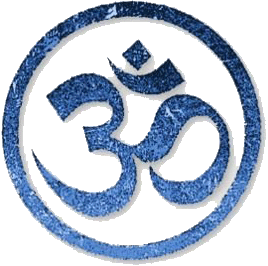 Poornima:
Poornima: Hindu holy day. The Full Moon Day that defines the Hindu lunar month’s unique qualities.
Standard Time:
Standard Time resumes: U.S. (American) date/time. At 2 a.m. the time switches from Daylight Savings Time to Standard Time in most of the U.S.A.
lunar information 2009
| Moon: | Full Moon | in Taurus | |
Next Waning Quarter November 9 | Next New Moon November 16 | Next Waxing Quarter November 24 | Next Full Moon December 2 |
Second Quarter in Taurus:
Second Quarter: The moon is in the second (2nd) quarter (waxing gibbous) in Taurus.
Full Moon:
Full Moon: Lunar. Occurs at 2:14 p.m. Eastern Standard Time (EST) in 2009. This is a Wiccan Esbat. Also known as the Mourning Moon. See also Isis Full Moon love spell.
Third Quarter in Taurus:
Third Quarter: The moon is in the third (3rd) quarter (waning gibbous) in Taurus.
Planting: The Moon makes this day excellent for planting.
Fishing: The Moon makes this day excellent for fishing.
Taurus Rewarding: This day in 2009 is rewarding for those who are Sun sign Taurus because the Moon is in your Sun sign.
Scorpio Challenging: This day in 2009 is challenging for those who are Sun sign Scorpio because the Moon is in the sign opposite your Sun sign.
astrological information 2009
Venus Quincunx Uranus: Venus is quincunx Uranus at 6:12 a.m. Eastern Standard Time (EST).

 Moon Square Mars: The Moon is square Mars at 9:41 a.m. Eastern Standard Time (EST).
Moon Opposite Mercury: The Moon is in opposition with Mercury at 11:04 a.m. Eastern Standard Time (EST).
 Sun Opposite Moon: The Sun is in opposition with the Moon at 2:14 p.m. Eastern Standard Time (EST). Full Moon.
 Venus Trine Neptune: Venus is trine Neptune at 6:21 p.m. Eastern Standard Time (EST).
Magick Color:
Lavender: The magick color for this day, based on planetary influences and the day of the week, is lavender. You may want to burn a lavender candle or wear some lavender this day.
Magick Incense:
Basil, Lavender, Neroli: The magick incense for this day, based on planetary influences, is neroli. The magick incense for this day, based on the day of the week, is lavender or basil. You may want to burn basil, lavender, or neroli incense this day. You may substitute a similar incense if you don’t have or don’t like basil, lavender, or neroli.
See also the article on incense. An American source for high quality incense is Mountain Rose Herbs. A British source for incense is Pagan Magic. Another American source for incense is Pagan Shopping.
holy days 2007 and 2008
These holy days are on different day each year on the solar calendar.
Maidyoshahem:
Maidyoshahem: Zoroastran holy day. ‘Mid-summer’ feast, one of the seven obligatory feasts of Zoroastrianism and one of the six gahanbars (or gahambars). The gahanbars date back to the pre-Zoroastrian agricultural people of the Iranian Plateau and mark the changing of the agricultural seasons. The gahanbars were absorbed into Zoroastrianism as religious holy days and are celebrated with feasting and fun.
In the Fasli (seaonsal) calendar, Maidyoshahem is celebrated from June 29 to July 3. In the Shahanshahi (or Shenshai) calendar, Maidyoshahem is celebrated from November 28 to December 2 during the years 2005, 2006, 2007, and 2008. In the Qadimi (ancient) calendar, Maidyoshahem is celebrated from October 29 to November 2 during the years 2005, 2006, 2007, and 2008.
Daylight Savings Time Ends:
Daylight Savings Time Ends: United States. Daylight Savings Time ends in the U.S. at 2 a.m. in 2007 and 2008 (return to Standard Time).
lunar information 2008
First Quarter in Sagittarius:
First Quarter: The moon is in the first (1st) quarter (waxing crescent) in Sagittarius.
Void of Course:
Moon Void of Course: The moon is Void of Course (V/C) starting at 4:41 a.m. Eastern Standard Time (EST).
Moon enters Capricorn:
 Moon Enters Capricorn: Lunar Ingress. The Moon enters the sign Capricorn at 6:13 a.m. Eastern Standard Time (EST).
First Quarter in Capricorn:
First Quarter: The moon is in the first (1st) quarter (waxing crescent) in Capricorn.
astrological information 2008
Neptune Goes Direct:
D Neptune Goes Direct: Neptune goes direct at 21° 28'in the sign Aquarius at 1:38 a.m. Eastern Daylight Savings Time (EDT).

 Moon Conjunct Pluto: The Moon is in conjunction with Pluto at 4:41 a.m. Eastern Standard Time (EST). Moon Void of Course (V/C).









 using
using  .
.